

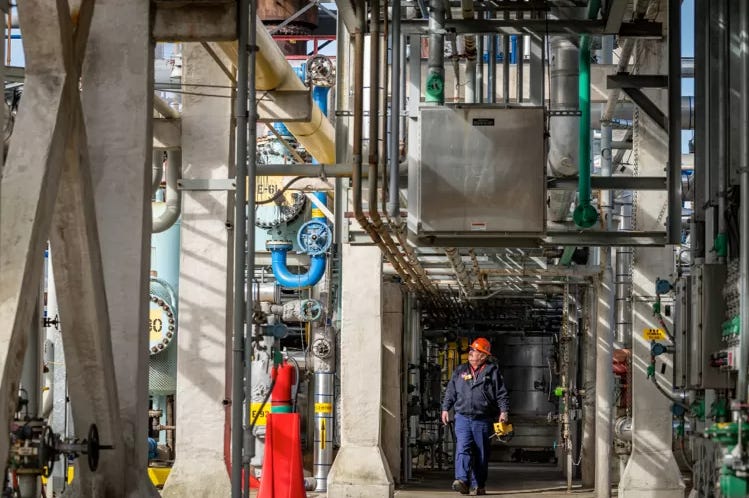
Much of the fuel that keeps Hawaii running depends on a single mooring buoy 1.7 miles off Barbers Point, according to Honolulu Civil Beat’s reporting this month. That buoy feeds the only refinery in the state. Whatever the refinery can’t make, the islands import, and one analysis found that 88% to 100% of those finished-fuel imports come from a single country: South Korea.
Hold that picture next to a different number. The diesel crack spread, the gap between what diesel sells for and what the crude inside it costs, has broken $100 a barrel. That is a record, and it happened while crude itself was moving sideways.
It isn’t supposed to work this way. Refining margins are meant to follow oil. Stillwater Associates, a refining consultancy, argues that diesel has decoupled from crude and is now priced by how much demand has to disappear to match the missing supply. The supply really is missing. U.S. distillate inventories sit roughly 12% to 16% below their five-year average, depending on the week and the source. American refineries are running at about 97% of capacity, with no headroom left. About a third of U.S. distillate output is being exported. Around 1.5 million barrels a day of global diesel supply, roughly 5% of world demand, is offline because of the Hormuz closure, Russian export bans and attacks on refineries. Retail diesel is above $6 a gallon.
A strange market for good news
None of this is landing in a friendly tape. The Fed raised rates on September 16, its first hike since 2023, and 16 of 19 officials expect at least one more this year. The 10-year Treasury yield is sitting near 5.24%. Consumer confidence just hit a 12-year low. In that environment, an industry whose earnings are actually arriving should be a magnet.
The biggest refiners already had their run: as of late July, Marathon Petroleum and Valero had nearly doubled this year and Phillips 66 was up two-thirds. The easy part of this trade is public.
The harder part shows up in how one of these companies was treated after it reported. Its latest quarter delivered $462 million of net income and $571 million of adjusted EBITDA, against $138 million a year earlier. The whole company is worth about $3.9 billion today, so one quarter of profit equals roughly 12% of its market value.
The stock fell 15.8% the next day, from $83.00 to $69.92.
Investors weren’t disputing the quarter. They were deciding it was a peak, and they may be right about part of it. Some of that record was timing: crude bought ahead of the spike and product sold after it, a net price-lag benefit of about $76.5 million in Hawaii alone. Management also said July’s margins ran below the second-quarter average and cautioned against extrapolating.
So the question isn’t whether the quarter was good. It’s what this business earns when “good” is less spectacular, and whether the price already assumes that answer. That depends on details a headline skips: what the company owes, what taxes it stops sheltering next year, what one regulatory ruling and one asset sale could add, and how much of its profit rides on a single point of failure.
One mid-cap refiner sits at the center of all of it, and its stock is priced as if the good news has an expiration date.
The company?
Par Pacific Holdings (NYSE: PARR).
Par Pacific operates four refineries with roughly 219,000 barrels a day of capacity, plus logistics assets and a retail network under brands like Hele and 76. They sit in Kapolei, Hawaii; Billings, Montana; Tacoma, Washington; and Newcastle, Wyoming. Each sells into an isolated regional market with its own price index, which is why the same crisis paid them very differently last quarter: the Hawaii index averaged $46.06 a barrel against $8.57 a year earlier, while Washington’s was $20.27.
Hawaii is the prize. The refinery’s adjusted gross margin was $57.00 a barrel, versus $10.18 a year ago. Par also supplies about half of the diesel the U.S. military uses in Hawaii and is its principal jet fuel supplier, per Civil Beat. That is a scarce, hard-to-replicate position, and it explains how a $3.9 billion company posts a $571 million EBITDA quarter.
